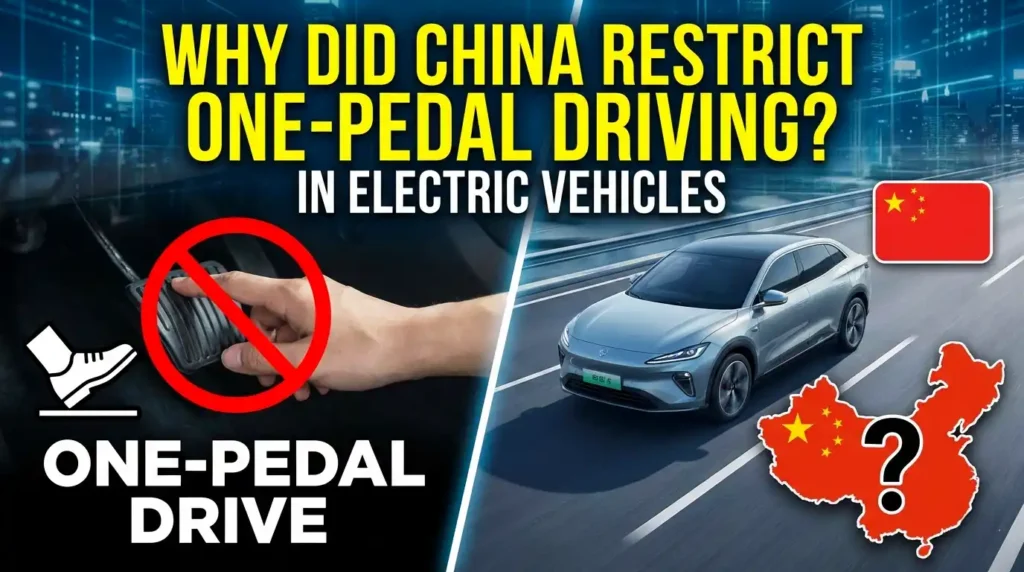
What Is One-Pedal Driving?
One-pedal driving allows drivers to control a vehicle’s speed using only the accelerator pedal. Under this system, the vehicle:
-
Accelerates when the accelerator pedal is pressed
-
Decelerates when the driver lifts their foot
-
Can, in many cases, come to a complete stop without using the brake pedal
This behavior is enabled by regenerative braking, a technology that converts kinetic energy produced during deceleration into electrical energy, which is then fed back into the vehicle’s battery.
As a result, one-pedal driving offers several advantages:
Due to these benefits, one-pedal driving has become especially popular among EV drivers, particularly in dense urban environments where frequent stopping is common.
Did China Ban One-Pedal Driving?
The short answer is no.
China has not banned one-pedal driving. Instead, regulators have decided to:
-
Prohibit one-pedal driving from being activated as a default factory setting
-
Allow drivers to enable it manually as an optional feature, if the vehicle is equipped with the system
This distinction highlights China’s regulatory approach, which focuses on risk management and driver awareness rather than outright technological restriction.
The Main Reason Behind the Decision: Road Safety
According to studies conducted by Chinese regulatory authorities, several safety concerns were identified:
-
Some drivers become overly dependent on regenerative braking
-
This dependency can delay reaction times when maximum braking force is required
-
In certain emergency situations, regenerative braking alone does not provide sufficient stopping power
Regulators concluded that enabling one-pedal driving by default could create a false sense of security, particularly for inexperienced drivers or those unfamiliar with how regenerative braking behaves under critical conditions.
By requiring drivers to manually activate the feature, authorities aim to ensure that users are consciously aware of how the system works before relying on it in real-world driving scenarios.
What Does the GB 21670–2025 Standard Include?
The GB 21670–2025 regulation goes beyond one-pedal driving and introduces a broader set of safety requirements, which will be implemented gradually through 2027.
1. Brake Lights During Deceleration
Starting January 1, 2026:
-
Brake lights must automatically illuminate
-
When vehicle deceleration exceeds 1.3 m/s²
-
Even if the brake pedal is not pressed
This measure is intended to alert following drivers and significantly reduce the risk of rear-end collisions, especially in traffic conditions where regenerative braking causes rapid deceleration.
2. Mandatory ABS Systems
The standard also mandates that:
ABS technology helps to:
-
Improve vehicle control during emergency braking
-
Prevent wheel lock-up and skidding
-
Shorten stopping distances
-
Reduce accident rates and insurance costs
Balancing Innovation and Safety
Automotive experts widely view these regulatory changes as:
-
Evidence that regulators are not opposed to technological innovation
-
An effort to create a more mature and standardized regulatory framework for EV technologies
-
A move toward improving driver education and responsibility
While one-pedal driving remains efficient and convenient, experts emphasize that it requires a clear understanding of vehicle behavior, particularly during emergency braking situations.
What Does This Mean for the Future of Electric Vehicles?
China’s decision reflects several broader trends:
-
The growing maturity of the EV market
-
A transition from rapid adoption to structured regulation
-
A strong emphasis on safety alongside environmental and energy efficiency goals
These standards are expected to:
-
Influence global automakers operating in the Chinese market
-
Shape future EV system designs worldwide
-
Potentially serve as a regulatory benchmark for other countries considering similar measures
Conclusion
China is not targeting one-pedal driving itself, but rather regulating how and when it is used. The primary objectives of the GB 21670–2025 standard are to:
This approach reinforces a key message for the future of electric mobility: innovation must be paired with responsible and safety-focused regulation.