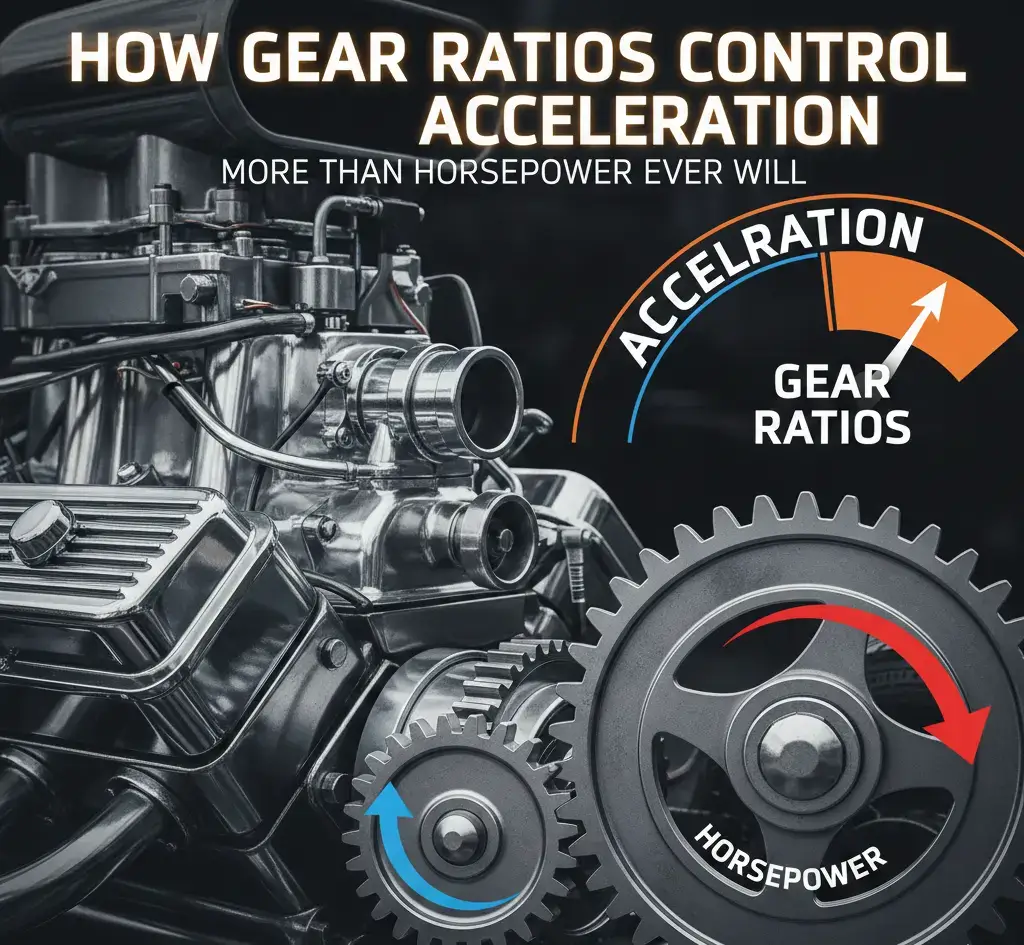
Most people believe acceleration is all about horsepower. In reality, gear ratios play a much bigger role in how fast a car accelerates, especially in real-world driving. Two cars with the same engine power can feel completely different simply because of how their gears are set up.
This article explains, clearly and scientifically, how gear ratios control acceleration and why they matter more than most drivers realize.
1. What a Gear Ratio Actually Does
A gear ratio determines how many times the engine rotates for one rotation of the wheels.
Short gear ratio → engine spins more → more torque at the wheels
Long gear ratio → engine spins less → less torque at the wheels
The engine itself produces torque, but the gearbox multiplies that torque before it reaches the tires.
This means:
Wheel torque = engine torque × gear ratio
Acceleration depends on wheel torque, not engine torque alone.
2. Why Short Gears Feel Faster
Cars with short gearing feel aggressive and punchy because:
the engine stays in its power band
torque multiplication is high
throttle response feels instant
low-speed acceleration is strong
This is why:
small turbo engines feel fast in the city
hot hatches feel explosive off the line
some low-horsepower cars feel quicker than powerful ones
Short gears trade top speed for acceleration — and that trade often feels amazing in daily driving.
3. Long Gears Feel Slower (But Have a Purpose)
Long gear ratios reduce engine RPM at speed. They are designed for:
fuel efficiency
highway comfort
lower noise
lower emissions
But the downside is clear:
weaker low-speed acceleration
slower response
less urgency
That’s why many modern cars feel “lazy” despite decent horsepower. The engine has power, but the gearbox doesn’t let you use it immediately.
4. Gear Ratios vs Horsepower: A Simple Example
Car A:
200 hp
short gearing
Car B:
300 hp
long gearing
From 0–60 km/h or 0–100 km/h: Car A can accelerate faster
From high speed: Car B pulls harder
This proves an important rule:
Acceleration is about torque at the wheels, not power on paper.
5. Why Sports Cars Use Close Gear Ratios
Performance cars use close-ratio gearboxes, meaning gears are spaced tightly together.
Benefits:
engine stays near peak power
minimal RPM drop during shifts
constant acceleration
better control
This is why sports cars:
feel smooth under hard acceleration
respond instantly
dominate on track
It’s not magic — it’s smart gearing.
6. Automatic vs Manual: Gear Ratio Behavior
Manual Transmissions
fixed gear ratios
driver controls RPM
more mechanical connection
Manual cars often feel faster because drivers keep the engine in the power band.
Automatic & Dual-Clutch (DCT)
optimized shift timing
faster shifts
aggressive low gears
Modern automatics often outperform manuals because they use:
extremely short first gears
multiple gear steps
perfect shift logic
CVT Transmissions
CVTs don’t have traditional gears. They keep the engine at peak power RPM.
Result:
smooth acceleration
no “kick”
less emotional feel
CVTs can be efficient, but many drivers dislike the disconnected sensation.
7. Why Gear Ratios Affect Traction
Short gears deliver huge torque instantly. If traction is limited:
wheelspin increases
traction control intervenes
acceleration slows
This is why:
powerful cars struggle in first gear
AWD systems help short gearing
traction limits acceleration, not power
Gear ratios and traction are deeply connected.
8. Why Manufacturers Choose “Boring” Gears
Car makers intentionally use longer gearing to:
pass emissions tests
reduce fuel consumption
meet noise regulations
increase engine lifespan
They sacrifice excitement for compliance.
That’s why many tuned cars feel faster without adding power — tuning often removes torque limits and alters gear behavior.
9. Real-Life Driving: Where Gear Ratios Matter Most
Gear ratios control:
city responsiveness
overtaking speed
highway merging
driving enjoyment
This is why rolling acceleration (60–120 km/h) depends heavily on:
gear selection
downshift logic
ratio spacing
A car with smart gearing will always feel faster than one with lazy ratios.
Final Verdict
Horsepower defines potential.
Gear ratios decide how much of that potential you actually feel.
Short gears = faster acceleration, stronger response, more excitement.
Long gears = efficiency, comfort, and calmer driving.
If you want a car that feels fast in real life, don’t just look at horsepower numbers. Look at:
gear ratios
transmission type
torque curve
how the power is delivered
Because acceleration starts in the gearbox, not the engine.
For readers who want a deeper technical explanation of how gear ratios multiply torque and affect wheel speed, this resource breaks down the mechanics and math behind gear ratios in a simple but accurate way:
https://en.wikipedia.org/wiki/Gear_ratio
more sources :
New World Encyclopedia — Gear ratio
• Explains the relationship between gear teeth and rotation speeds, with examples. Gear ratio (New World Encyclopedia)Merriam-Webster Dictionary — Gear ratio definition
• Simple engineering definition of the term. Gear ratio (Merriam‑Webster)Dictionary.com — Gear ratio meaning
• Another general definition focusing on mechanical context. Gear ratio (Dictionary.com)Collins English Dictionary — Gear ratio
• Clear entry with automotive engineering context (engine/transmission). Gear ratio (Collins Dictionary)
The $45k Rivian R2: This is the make-or-break moment for Rivian. Review its ability to compete with the Tesla Model Y in the mass market.
Electric vs Hybrid Cars: Which Is the Smarter Choice in 2026?

Will Manual Transmissions Make a Comeback in Modern Cars?
The Reality of the Driverless Car: Where We Are Now (and Why We Aren’t All Level 5 Yet)
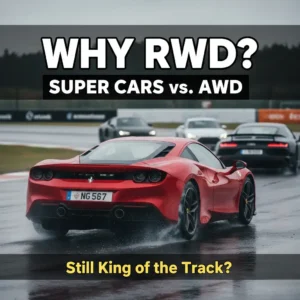
Why Some Supercars Still Use Rear-Wheel Drive(RWD) Instead of AWD
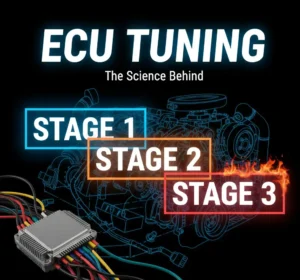
How ECU Tuning Really Works — The Science Behind Stage 1, 2, and 3
Table of Contents