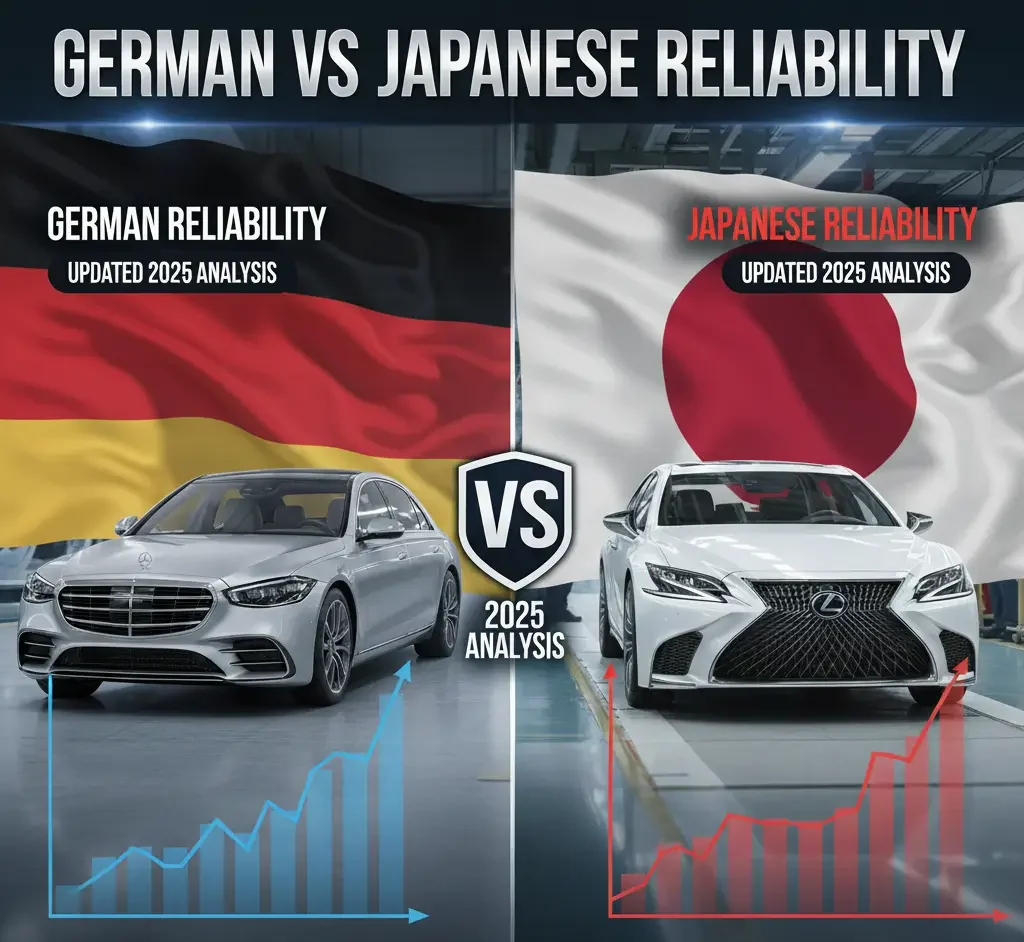
German vs Japanese Reliability: Updated 2025 Analysis
For decades, the debate has been the same:
Are German cars or Japanese cars more reliable?
In 2025, the gap is still real — but the reasons behind it are more complex than people think.
Here’s the full breakdown.
1. Engineering Philosophy: The Root of the Difference
🇯🇵 Japanese Philosophy: “Keep It Simple. Keep It Consistent.”
Japanese brands (Toyota, Honda, Lexus, Subaru, Mazda…) focus on:
fewer mechanical complexities
proven long-life components
extremely conservative software tuning
minimizing turbo and electronics stress
easy maintenance and universal parts availability
This leads to:
✔ fewer failure points
✔ cheaper repairs
✔ extremely long engine/transmission life
This is why many Japanese engines pass 300,000 km with basic maintenance.
🇩🇪 German Philosophy: “Maximum Performance. Maximum Precision.”
German brands (BMW, Mercedes, Audi, VW…) aim for:
performance
handling
luxury
advanced electronics
complex engineering
high-tech materials
This creates:
✔ better driving experience
✔ more power
✔ more advanced features
But also:
✘ more components that can fail
✘ higher heat + pressure due to turbo engines
✘ expensive repairs
✘ complicated electronics
German cars are great to drive — but expensive to own long-term.
2. Reliability Trends in 2025 (Realistic Summary)
Japanese brands still dominate long-term reliability, especially after 5+ years of ownership.
2025 General Trend Summary
Toyota & Lexus = still #1 in global reliability ratings
Mazda = extremely strong mechanical reliability
Honda = stable long-term powertrain performance
Subaru = solid but with specific weak points (gaskets, CVT)
Meanwhile:
BMW improved reliability after 2020, but still high maintenance costs
Mercedes-Benz remains strong in engines, weaker in electronics
Audi solid performance but expensive electrical repairs
VW mid-range reliability depending on engine platform (TSI/TDI)
Long-Term Ownership (8–12 years)
Short-Term Ownership (0–5 years)
3. Why Japanese Cars Last Longer
Key Reason 1: Lower Stress on Components
Most Japanese engines:
run lower boost
use simpler transmissions
prioritize heat management
avoid unnecessary complexity
Less stress = fewer failures.
Key Reason 2: Conservative Technology
Japanese brands adopt new tech slowly.
This frustrates enthusiasts, but it keeps reliability high.
Key Reason 3: Parts Compatibility
Toyota, Honda, Suzuki, Nissan use globally standardized parts, lowering failure risk and cost.
4. Why German Cars Break More Often
Reason 1: High Turbo Pressure
German engines often run:
Heat kills components over time.
Reason 2: Electronics Overload
Screens, sensors, modules, driving systems…
When a German car ages, electronic failures become common and expensive.
Reason 3: Engineering Complexity
Great for performance.
Bad for simplicity.
5. Cost of Maintenance (2025 Reality)
Japanese:
German:
expensive parts
specialized mechanics required
expensive electronics
more sensors → more error codes
turbo + DSG + emissions systems increase risk
A 10-year-old German car may cost 3–5× more to maintain than a Japanese equivalent.
6. Which One Should YOU Choose?
Be honest with yourself. What do you want?
If you want:
reliability
low fuel consumption
low maintenance
stress-free ownership
→ Buy Japanese.
Perfect for Morocco’s climate, roads, fuel quality, and budget.
If you want:
luxury
power
performance
technology
prestige
→ Buy German.
But accept the maintenance costs — they’re high for a reason.
7. Final Verdict (2025)
Reliability Winner:
🇯🇵 Japanese
Still unmatched, especially after 5+ years.
Driving Experience Winner:
🇩🇪 German
Nothing beats them in comfort + performance.
Ownership Cost Winner:
🇯🇵 Japanese
Technology & Luxury Winner:
🇩🇪 German
Conclusion
German cars are amazing machines — fast, luxurious, beautifully engineered.
Japanese cars are unbeatable in reliability, cost of ownership, and long-term peace of mind.
Choose German with your heart.
Choose Japanese with your brain.