Introduction
Modern engines are no longer “mechanical machines only.” They are computers on wheels. The ECU (Engine Control Unit) decides how much power you get, how much fuel you burn, how reliable the engine stays, and even how much pollution it releases.
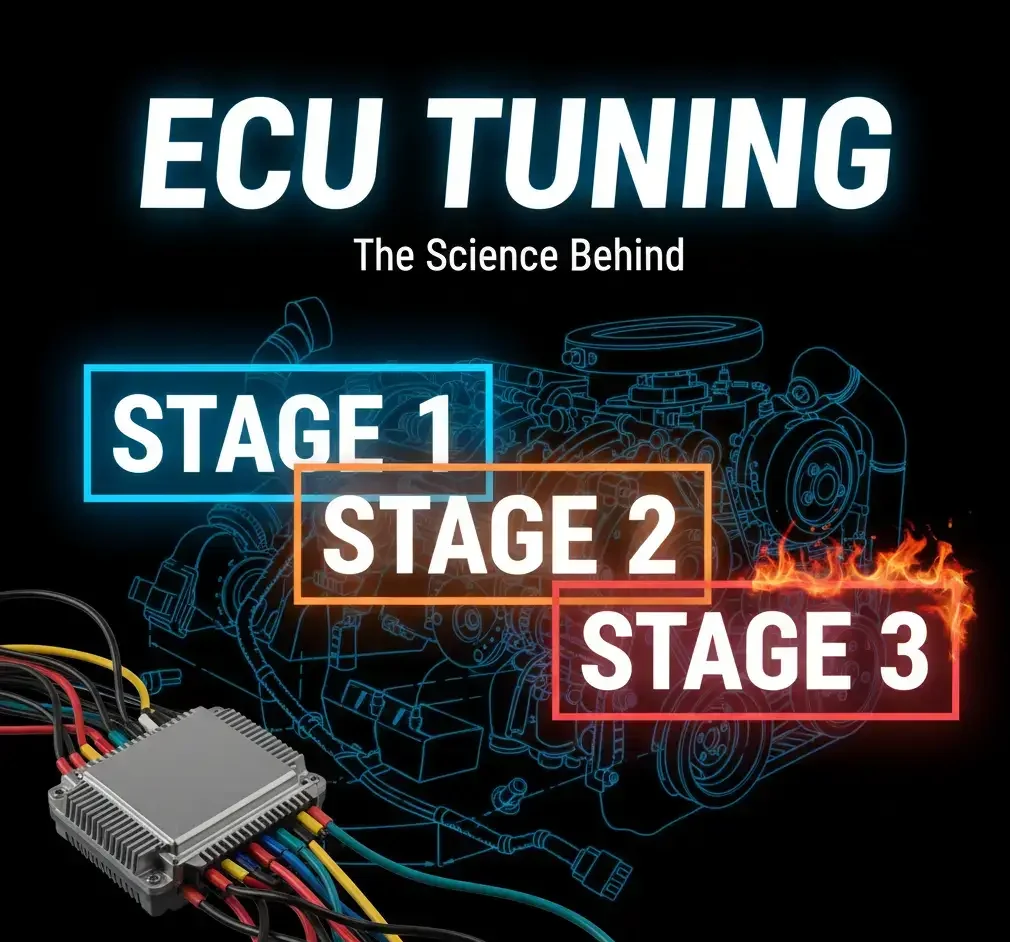
ECU tuning is simply reprogramming that computer to unlock more performance.
But the real science behind Stage 1, 2, and 3 is often misunderstood — until now.
1. What an ECU Actually Controls
The ECU monitors and adjusts:
Boost pressure (for turbo engines)
Air–fuel ratio (AFR)
Ignition timing
Fuel injection timing/duration
Throttle response
Torque limits per gear
Turbo wastegate control
Knock detection and safety limits
Every one of these parameters has a safe window determined by the engine’s construction.
When tuners modify these parameters, you get more power — but only if the engine can physically handle it.
2. The Science Behind More Power
(1) More Air + More Fuel = More Power
Horsepower is essentially a result of how much air and fuel you can burn efficiently inside the cylinders.
The ECU tuning does exactly this:
Increase boost (more air)
Inject more fuel
Advance timing to burn fuel better
Remove factory torque limits
(2) Factory Limits Are Ultra-Strict
Manufacturers leave a lot of “hidden potential” for:
Emission regulations
Fuel quality variations
Reliability over 200,000+ km
Driving comfort
Marketing (same engine, different trims)
This is why the same 2.0 turbo engine can make:
190 hp in Base model
252 hp in Premium model
…with only ECU changes.
3. What Stage 1, 2, and 3 REALLY Mean
Forget marketing. Here is the real, engineering-based explanation.
Stage 1 – Safe Software-Only Power
What it changes scientifically:
Hardware required: None
Risk: Very low
Power gain:
Who is it for?
Daily drivers who want easy, safe power without changing anything.
Stage 2 – More Airflow, More Heat, More Responsibility
Stage 2 supports higher boost because it removes airflow restrictions.
Required hardware:
Scientific effects:
Turbo works harder → more heat
Intercooler reduces air temperature → denser air → more oxygen
Downpipe reduces back-pressure → turbo spools faster
Power gain:
Risk: Medium
If cooling and fuel quality are poor, knock risk increases.
Stage 3 – Big Turbo, Big Fuel, Big Responsibility
Stage 3 is not for beginners.
It involves major mechanical changes.
Hardware:
Scientific effects:
Power gain:
Risk: High
Requires perfect tuning, good fuel, and constant monitoring.
Daily reliability drops.
4. Fuel Quality Matters More Than People Think
Morocco: 91–95 octane
Europe: 95–98 octane
Higher octane = engine can run more timing and higher boost without knocking (detonation), which is deadly.
If fuel is bad → power will drop → engine protection activates.
5. Will ECU Tuning Damage Your Engine? (Honest Answer)
Stage 1:
If the tuner is good → 99% safe
Stage 2:
Safe only if cooling upgrades are done properly.
Stage 3:
If you daily it → you’re stressing the engine much more than factory levels.
Expect shorter turbo life, more heat, and higher maintenance.
Science doesn’t lie.
6. Should YOU Tune Your Car?
If your goal is:
More fun and great response: Stage 1
Aggressive performance: Stage 2
Track-level power: Stage 3
But if you want a long lasting daily car and money is tight → don’t go above Stage 1.
Conclusion
ECU tuning works because it unleashes airflow, fuel control, and ignition timing the factory had restricted.
Stage 1 is safe for daily life.
Stage 2 is fun but hotter.
Stage 3 is a commitment.