The Electric 'Holy Grail': Why Solid-State Batteries Will Change EVs Forever (And Why We Care in 2026)
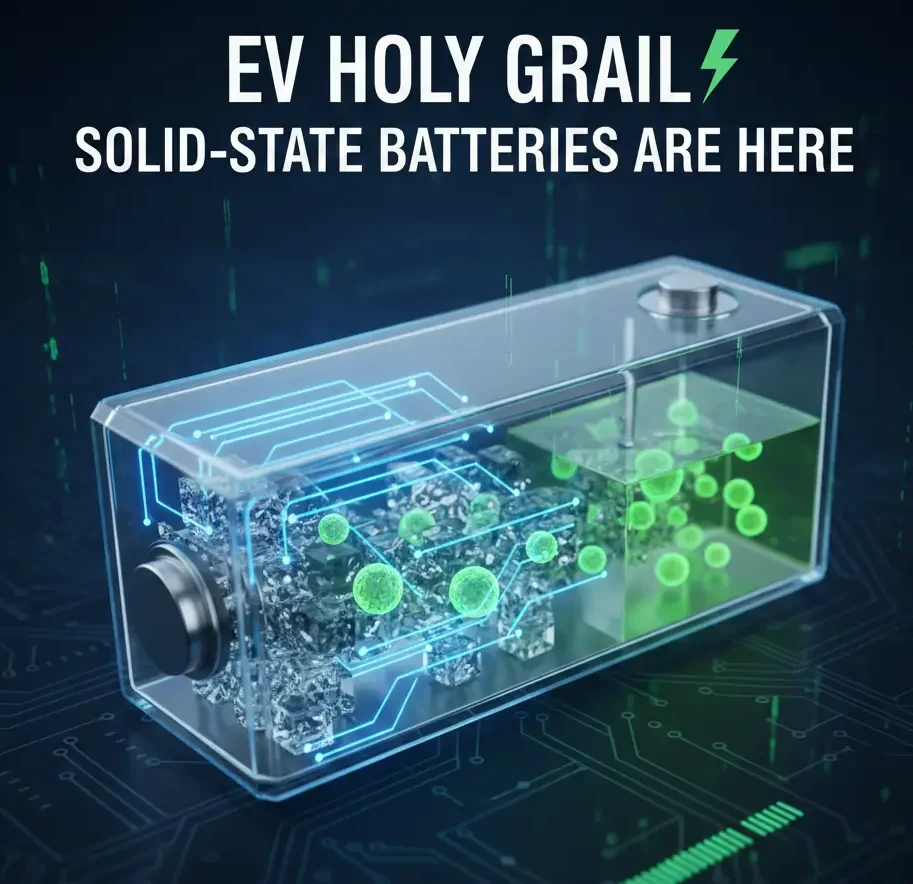
The electric vehicle revolution has been simmering for years. While millions have adopted EVs, there’s always been a “but”-a hurdle holding back the rest of the world. That hurdle boils down to two things: range anxiety (how far can I go?) and charging speed (how long will it take?).
Enter the solid-state battery, the technology that promises to solve both problems and make today’s EV concerns seem as quaint as a dial-up modem. By 2026, the technology is likely to leave the lab and hit the road, fundamentally reshaping the automotive landscape.
Understanding Today: The Problem with Liquid
To fully appreciate the solid-state revolution, we need to understand the technology powering nearly all EVs right now: lithium-ion, or Li-ion, batteries.
The Li-ion battery stores and releases energy by transferring tiny, charged particles called lithium ions between the two electrodes: the cathode (positive end) and the anode (negative end).
The crucial part is the path of travel: the ions are moving through a liquid electrolyte. You can think of that liquid as the bloodstream of the battery.
While efficient, this liquid offers some drawbacks:
Safety Hazard: The liquid electrolyte in many cases is flammable. When the battery is damaged or overheated, it may provoke a dangerous reaction referred to as thermal runaway, which actually means a battery fire.
Density Limit: You can only put so much energy into a cell for safe operation before the liquid becomes a limiting factor, putting a cap on how far the car can drive.
Charging speed: When too much power is pushed into the battery too fast, the liquid structure can get damaged and form undesirable deposits, slowing it down during high-speed charging.
The Game Changer: Switching to a Solid State
The concept of an SSB is elegantly simple: replace the flammable liquid electrolyte with a solid material. That, however, is anything but simple to engineer, but the resulting benefits are massive:
1. Range: Go Further and Stop Less
Because the solid material is so much more stable, engineers working on batteries can use a pure lithium metal anode. That material can hold far more energy than the carbon-based anodes in liquid batteries.
The Result: You can put more energy in the same space. This means an EV battery pack that’s both much smaller and lighter and yet gives you 50-100% more range. Visualize a car no bigger than a Tesla Model 3, which achieves 500 to 700 miles of real-world range—the real alternative to any gas car on a road trip.
2. Charging: Minutes, Not Hours
The solid electrolyte allows lithium ions to pass through it at much faster rates without degrading the core structure of the battery.
The Result: The barrier to fast charging is effectively removed. We’re talking about charging times from near-empty to 80% capacity in under 15 minutes, approaching the time it takes to stop and fill a gasoline tank. This demolishes the last major argument against long-distance EV travel.
3. Safety: The Peace of Mind Factor
Because the solid material is not combustible and very stable, the possibility of thermal runaway is drastically reduced.
Why 2026 Is the Tipping Point
Solid-state technology isn’t new—it’s been the focus of major R&D for decades. What makes 2026 so important is the transition from research to reality.
Global auto giants like Toyota (who hold numerous solid-state patents) and battery manufacturers like CATL and QuantumScape have committed to initial, large-scale production runs for vehicles around this time. This suggests that the two biggest hurdles—manufacturing at scale and cost reduction—are finally being overcome.
The Big Debate
By 2026, the key debate won’t be about whether solid-state batteries can be made, but how quickly they can scale up to meet demand.
This technology is poised to be the final push for mass EV adoption. When batteries offer superior range, lightning-fast charging, and greater safety than gasoline, what rational argument will remain for purchasing a combustion engine car?
Solid-state batteries are more than just a component upgrade; they are the necessary foundation for a fully realized electric future. Prepare for the conversation to shift from “Will my EV make it?” to “Where should I go next?”
Table of Contents