The Reality of the Driverless Car: Where We Are Now (and Why We Aren't All Level 5 Yet)
1. The Hype vs. The Highway: Why Self-Driving Isn't Everywhere (Yet)
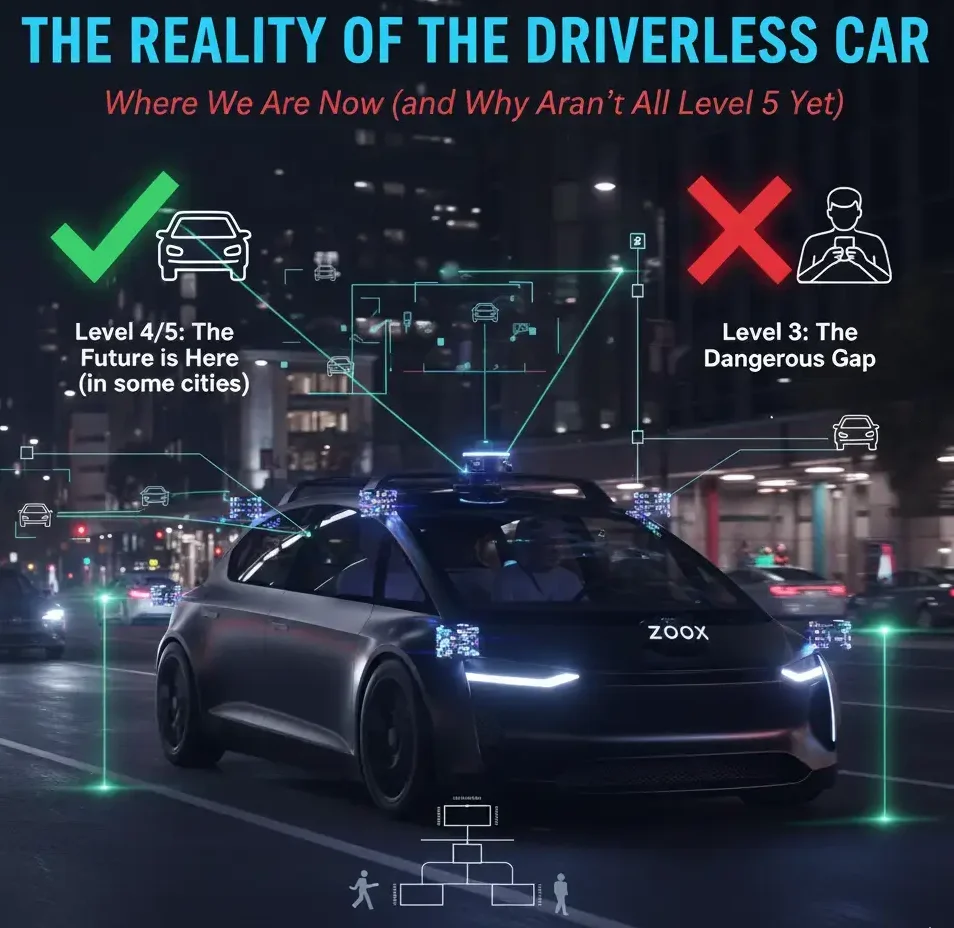
For years, the promise has been clear: Level 5 autonomy, a world where the steering wheel is optional and traffic jams are a relic of the past. Major tech companies and automakers poured billions into realizing this future, leading many consumers to believe that fully driverless cars were just around the corner. Yet, while features like advanced adaptive cruise control and lane-keeping are common, the true, hands-off, eyes-off experience remains heavily restricted. This gap between the futuristic hype and the current reality is leading to confusion and, sometimes, danger. To truly understand where the industry stands, we need to distinguish between what cars can assist with today (Level 2) and what they can fully manage (Level 4 and 5).
2. The Stakes Are Higher Than Speed: Ethics and Liability
The challenge of creating a truly autonomous vehicle goes far beyond sophisticated sensors and powerful processors. The transition from human control to machine control introduces profound ethical dilemmas that coders and manufacturers must grapple with. In an unavoidable accident, who does the car prioritize: the occupant, a pedestrian, or a cyclist? Furthermore, when a crash occurs, the legal and insurance frameworks fall apart. Who bears the liability? The driver who was monitoring the system, the software company that wrote the code, or the manufacturer of the hardware? These non-technical hurdles are proving to be the most complex roadblocks to mass adoption, demanding not just engineering solutions, but new societal and legal consensus.
Understanding the Road: The 6 Levels of Autonomy
The first step to understanding AVs is knowing the language. The Society of Automotive Engineers (SAE) defines six levels of driving automation.1 This is where most people get confused: the car you drive today likely has features from Level 1 and 2, but is miles away from Level 5.
| SAE Level | Description | Driver Role | Real-World Example |
| Level 0 | No Automation | Driver performs all tasks. | Basic car with no cruise control. |
| Level 1 | Driver Assistance | Driver performs all but one task (e.g., steering OR accelerating/braking). | Standard Cruise Control. |
| Level 2 | Partial Automation | Vehicle controls both steering AND acceleration/braking. Driver must constantly monitor. | Tesla Autopilot, Ford BlueCruise, GM Super Cruise. |
| Level 3 | Conditional Automation | Vehicle handles all driving tasks in specific conditions (e.g., highway traffic jams). Driver can be temporarily distracted but must be ready to take over. | Mercedes-Benz DRIVE PILOT (in approved areas). |
| Level 4 | High Automation | Vehicle can drive itself entirely within a specific geographic area or operating condition (ODD). No driver attention needed within ODD. | Waymo & Zoox robotaxi services in defined city zones. |
| Level 5 | Full Automation | Vehicle can drive itself in all conditions, everywhere. No steering wheel or pedals needed. | The true “driverless” future. (Still in development.) |
Another challenge was time. By the time the SGP Sla 16 was being developed, the war had turned against Germany. Bombings, material shortages, and lack of manpower slowed all high-tech projects. The army shifted its focus toward simpler, faster solutions rather than experimental engines that needed months or years of testing.
Finally, logistics killed the project. An air-cooled diesel X-16 was extremely ambitious, and while it might have performed well if completed, the war simply didn’t leave enough room to finalize, test, and produce it.
The Current Reality: Level 2 Dominates, Level 4 is Emerging
Most vehicles on the road today are maxed out at Level 2. This is a powerful assist feature, but it is not self-driving. Companies like Waymo and Zoox are successfully deploying Level 4 vehicles, but only in highly-mapped, specific areas (like downtown San Francisco or Phoenix).
Key Takeaways from the Current Landscape:
Safety Data is Promising: Data from Level 4 operators like Waymo suggests their driverless cars have significantly fewer injury-causing crashes than human-driven benchmark vehicles in the same cities (up to 80-90% fewer in some categories). This indicates AVs are a massive public health opportunity.
The “Human Problem” at Level 3: The technological gap between Level 2 and Level 3 is huge, but the human gap is even bigger. Expecting a human to be “on standby” but not focused has proven difficult and dangerous in testing, which is why many companies are skipping straight to Level 4.
AVs are Smarter, Not Wiser: AVs excel at following rules and avoiding distracted mistakes. They struggle with “common sense”—like interpreting a police officer’s hand signal, understanding that a nervous driver might brake unexpectedly, or dealing with unusual debris (the “edge cases”).
The Unavoidable Dilemma: Who Does the Car Save?
This is where the technology becomes philosophy. The classic “Trolley Problem” is now a software engineering question: How do you program a car to react in an unavoidable accident?
Imagine a scenario where the car must choose between two negative outcomes:
Swerve and hit a parked car, but save a pedestrian.
Stay the course and protect the occupant, but hit a cyclist.
AVs operate on algorithms based on pre-programmed ethical frameworks. Designers are forced to make value judgments—do they prioritize the safety of the paying occupant (Deontology) or minimize the overall harm to the public (Utilitarianism)?
This is a fundamental challenge because society itself hasn’t unanimously agreed on the right answer, making it impossible to write a definitive line of code.
The Roadblocks to Mass Adoption
Besides the technology and ethics, several practical hurdles are slowing the widespread rollout of Level 4 and Level 5:
Liability and Regulation: In a Level 5 crash, who is at fault? The passenger, the software developer, the car manufacturer, or the fleet operator? Current laws and insurance models are not designed for a driverless world.
Infrastructure Readiness: AVs rely heavily on robust data (5G, V2X communication, detailed 3D maps). Many roads lack the necessary “smart” infrastructure to support seamless, Level 5 operation in all weather conditions.
Public Trust and Acceptance: Despite strong safety data from leading operators, public opinion surveys often show high levels of distrust. Every high-profile AV accident, even a minor one, is a setback for public confidence.
Conclusion: A Partnership, Not a Takeover (For Now)
The reality of autonomous vehicles is a story of incredible progress limited by real-world complexity. The cars on our roads today are highly advanced partners, but we are still the drivers. Full autonomy (Level 5) remains the goal, but the journey involves solving not just engineering problems, but fundamental societal questions about trust, ethics, and responsibility.
Table of Contents