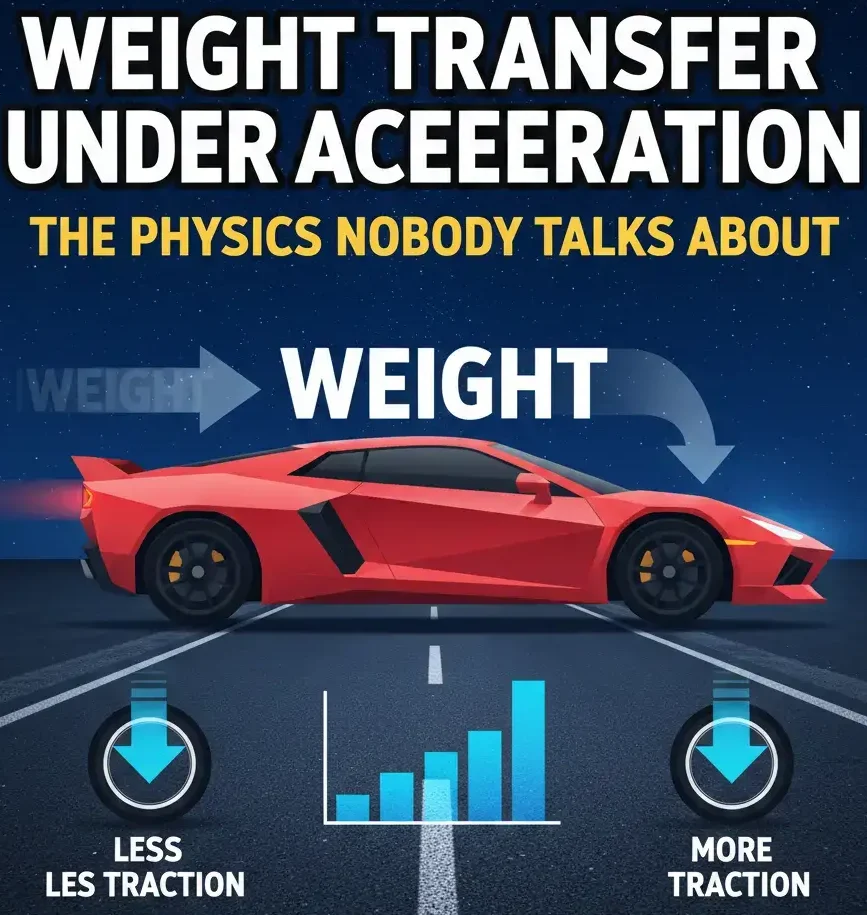
When people talk about fast cars, they obsess over horsepower, torque figures, and 0–100 km/h times. What almost nobody explains properly is weight transfer — a fundamental physical phenomenon that often decides whether a car launches hard or spins its tires uselessly.
Weight transfer is not marketing. It is not tuning folklore. It is pure Newtonian physics, and it applies to every vehicle that accelerates, from economy hatchbacks to hypercars.
What Is Weight Transfer?
Weight transfer is the redistribution of vertical load on a vehicle’s tires caused by acceleration or deceleration.
When a car accelerates:
The rear tires gain vertical load
The front tires lose vertical load
This happens because the car’s center of mass is above the ground. When acceleration force is applied at the tire contact patch, a rotational moment is created around the center of mass, pushing the rear downward and lifting the front.
Important correction: Mass does NOT move backward. Load transfers — not mass.
This distinction matters, and most people get it wrong.
The Physics Behind It (Simple but Precise)
The amount of longitudinal weight transfer is governed by this relationship:
Weight Transfer ∝ (Acceleration × Center of Mass Height) ÷ Wheelbase
That means:
Higher acceleration = more weight transfer
Higher center of mass = more weight transfer
Shorter wheelbase = more aggressive weight transfer
Nothing here mentions horsepower directly — because horsepower does not cause grip.
Why Weight Transfer Controls Acceleration
Tires generate grip based on normal force (vertical load). When the rear tires receive more load during acceleration, they can generate more longitudinal force up to a limit.
This is why:
Rear-wheel-drive cars benefit from acceleration
Front-wheel-drive cars struggle off the line
AWD systems exist to exploit load distribution
If the driven wheels do not have enough vertical load, they will spin — no matter how much power the engine produces.
Why FWD Cars Struggle From a Standstill
During hard acceleration:
Weight transfers away from the front
Front tires lose grip
Wheelspin occurs easily
This is why powerful FWD cars:
Require electronic torque limiting
Suffer from torque steer
Feel strong in rolling acceleration but weak from a stop
This is not a drivetrain “weakness” — it’s physics working against them.
Why RWD Works So Well for Performance Cars
Rear-wheel-drive benefits directly from weight transfer:
Rear tires get heavier under acceleration
Grip increases naturally
Power can be applied more progressively
This is why:
Drag cars are RWD
Supercars remain RWD
Track cars prefer RWD for throttle control
RWD doesn’t magically create grip — weight transfer feeds it grip.
AWD: Not Magic, Just Load Management
AWD does not remove physics. It redistributes torque to compensate for load imbalance.
AWD works best when:
Front tires lose some grip
Rear tires gain grip
Torque is actively shifted rearward
This is why modern performance AWD systems are rear-biased, not 50/50.
AWD improves consistency, not physics.
Why Center of Gravity Height Matters
SUVs and tall cars experience more weight transfer because their center of mass is higher.
This causes:
More rear squat
More front lift
Less steering precision under acceleration
This is why performance cars:
Sit low
Use stiff suspension
Minimize body movement
Lower center of gravity = controlled weight transfer, not elimination.
Suspension’s Role in Weight Transfer
Key truth: Suspension does NOT change how much weight transfers It changes how FAST it transfers
Soft suspension:
Slower weight transfer
More body movement
Better traction on uneven surfaces
Stiff suspension:
Faster transfer
Sharper response
Better control on smooth roads
This is why drag cars use soft rear suspension, while track cars go stiff.
Why Horsepower Alone Is Useless Without Weight Transfer
You can add:
Bigger turbos
More boost
Higher RPM
But if the driven tires cannot accept load, you gain nothing.
This is why:
300 hp cars beat 500 hp cars off the line
Tires matter more than engines
Chassis setup beats dyno numbers
Power is only useful after grip is available.
Real-World Example
Two cars:
Car A: 400 hp, FWD
Car B: 300 hp, RWD
From a stop:
Car A spins
Car B launches cleanly
From a roll:
Car A suddenly feels fast
Nothing changed except weight transfer behavior.
Final Truth (No Mercy)
If someone talks about acceleration without mentioning weight transfer:
They don’t understand vehicle dynamics
They’re repeating surface-level car content
Their conclusions are incomplete
Weight transfer is not optional knowledge.
It is the foundation of acceleration physics.
Ignore it, and you’ll keep believing horsepower myths.
External Scientific & Technical Sources
Engineering Explained – Vehicle Dynamics Basics
https://www.youtube.com/watch?v=9g3dJcYb9gkMilliken & Milliken – Race Car Vehicle Dynamics (Reference Text)
https://www.sae.org/publications/books/content/r-146/Wikipedia – Weight Transfer (Physics Overview)
https://en.wikipedia.org/wiki/Weight_transferTire Load Sensitivity (SAE Technical Explanation)
https://www.sae.org/publications/technical-papers/content/980909/
Table of Contents