Why AWD Isn’t Always Faster Than RWD in Real-World Driving
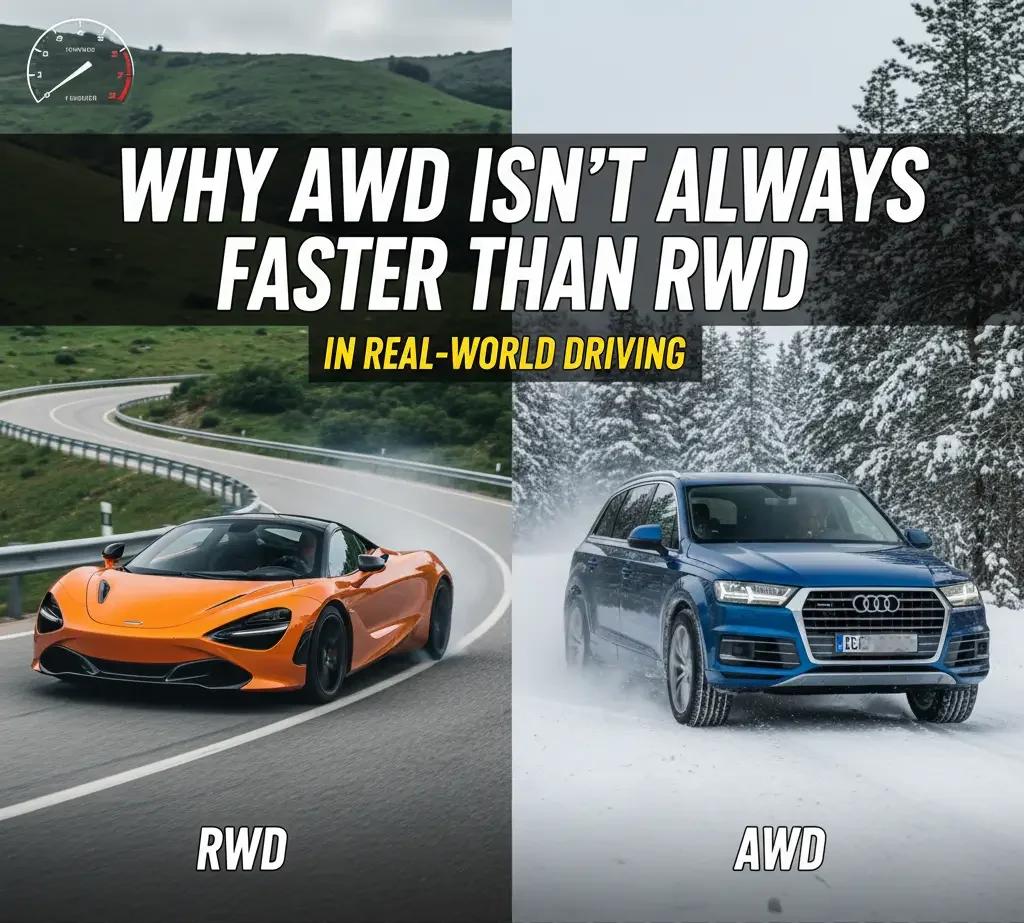
All-Wheel Drive (AWD) has a reputation for being the ultimate performance drivetrain. The logic sounds simple: more driven wheels = more grip = faster acceleration. That logic is incomplete.
In controlled environments—drag strips, snow, or rain—AWD often dominates. But in real-world driving, AWD is not always faster than Rear-Wheel Drive (RWD). In many everyday situations, RWD can match or even outperform AWD.
To understand why, we need to stop thinking in marketing terms and start thinking in physics.
1. Acceleration Is Limited by Grip and Weight Transfer
When a car accelerates, weight shifts rearward. This is basic physics: inertia resists forward motion, loading the rear tires and unloading the front ones.
RWD benefits directly from this
As weight transfers rearward, the driven wheels gain more vertical load, increasing available friction.AWD partially wastes grip
AWD sends power to the front wheels, but during acceleration the front axle is losing load. That means part of the drivetrain is working with less usable grip.
In straight-line acceleration on dry pavement, RWD naturally aligns with weight transfer. AWD fights against it.
2. AWD Systems Add Mass — and Mass Hurts Acceleration
AWD is heavier. Always.
Extra components include:
Front differential
Transfer case
Additional driveshafts
More complex axles
That added mass does two things:
Reduces acceleration (Newton’s second law: F = m·a)
Increases rotational inertia, which further slows response
In real-world speeds (30–120 km/h), where grip is usually sufficient, lighter RWD cars accelerate more efficiently than heavier AWD equivalents with similar power.
This is why many RWD sports cars feel quicker on the road, even when AWD cars win spec-sheet comparisons.
3. Drivetrain Losses Are Higher in AWD
Every mechanical component absorbs energy.
AWD systems typically lose:
20–25% of engine output through the drivetrain
RWD systems often lose:15–18%
That difference matters.
Even if two cars make the same engine power, the RWD car often delivers more usable power to the wheels. On dry roads, this can translate directly into faster acceleration once traction is no longer the limiting factor.
4. AWD Helps Launches — Not Rolling Acceleration
AWD shines at one thing: launching from a stop.
That’s why:
Drag races
0–100 km/h times
Marketing videos
…favor AWD.
But real-world driving rarely involves full-throttle launches from zero.
From rolling speeds:
Traction is already sufficient
Weight transfer favors the rear axle
Power becomes the limiting factor, not grip
In these conditions, RWD often accelerates just as fast—or faster—than AWD.
5. Torque Management Limits AWD Performance
Modern AWD cars rely heavily on electronic torque management systems to protect driveline components and maintain stability.
That means:
Power is often intentionally limited in lower gears
Front axle torque is reduced under certain conditions
The system prioritizes safety over maximum acceleration
RWD cars are mechanically simpler and often allow more direct throttle-to-wheel response, especially in performance-focused setups.
6. When AWD Is Faster (And When It’s Not)
AWD is faster when:
Road surface is wet, snowy, or loose
Launching from a standstill
Power levels exceed available rear-tire grip
RWD is faster when:
Road is dry
Acceleration starts from rolling speeds
Vehicle mass and drivetrain losses matter
Driver skill and throttle modulation are involved
This is why high-performance manufacturers still build RWD cars even when AWD technology is widely available.
7. Real-World Example
Many RWD sports cars with:
Lower weight
Better power-to-weight ratio
Shorter gearing
Can feel faster and more responsive than heavier AWD cars with similar or even higher power figures.
The stopwatch may favor AWD in perfect launches. The road often favors RWD.
Final Verdict: AWD Is Not Automatically Faster
AWD is a tool, not a guarantee.
It improves traction when grip is limited, but it comes with penalties:
Extra weight
Higher drivetrain losses
Less favorable weight transfer during acceleration
In real-world driving—dry roads, rolling speeds, daily use—RWD often delivers better acceleration efficiency and a more direct driving experience.
Believing AWD is always faster means falling for marketing, not physics.
More informations from external sources
Weight Transfer & Vehicle Dynamics
Race Car Vehicle Dynamics – Milliken & Milliken (concept reference used everywhere)
Weight Transfer Explained (University-level physics)
Drivetrain Losses (AWD vs RWD Efficiency)
Drivetrain Losses Explained – Engineering Explained
How AWD Systems Work & Their Efficiency
AWD vs RWD Real-World Performance
AWD vs RWD – Physics & Real Driving Conditions
Why AWD Isn’t Always Faster (Technical Perspective)
Torque Management & Electronic Limits
Torque Management Systems Explained
Why Cars Limit Torque in Lower Gears
Table of Contents