Why supercars still use RWD instead of AWD ?
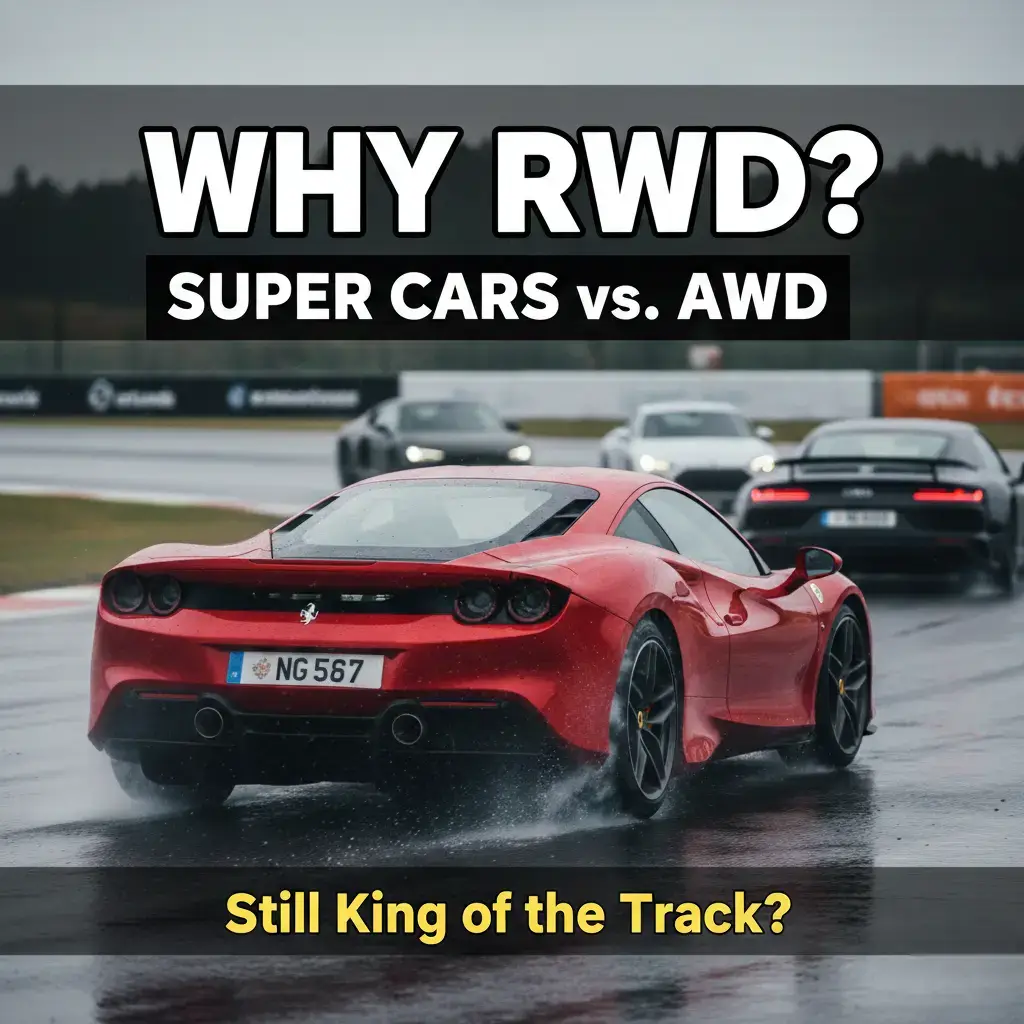
The Physics, Engineering, and Driver Feel Behind the Decision
Introduction
In the modern automotive world, all-wheel drive (AWD) is often marketed as the ultimate performance solution. More grip, faster launches, and better control — at least on paper. Yet, when you look closely at some of the world’s most respected supercars and track-focused machines, a surprising number of them still rely on rear-wheel drive (RWD).
This isn’t tradition. It isn’t cost-cutting. And it’s definitely not outdated thinking.
The reason is simple and brutal: physics doesn’t care about marketing.
Supercar engineers choose RWD in many cases because it delivers better balance, purer steering feedback, lower mass, and more predictable high-speed behavior — all critical factors when performance matters beyond straight-line acceleration.
Let’s break down exactly why RWD still survives — and thrives — in supercars.
1. AWD Improves Launches, Not Driving Feel
AWD’s biggest advantage is obvious: traction from a standstill.
By driving all four wheels, torque is distributed across a larger contact patch, allowing harder launches and quicker 0–100 km/h times.
However, supercars are not designed only for drag races.
Once the car is moving — especially above 60–80 km/h — traction is no longer the main limitation. At that point, factors like:
- Weight distribution
- Steering precision
- Chassis balance
- Throttle modulation
become far more important.
AWD systems add front driveshafts, differentials, transfer cases, and clutches, all of which increase complexity and mass. This extra hardware dulls steering feedback and reduces the “connected” feeling that elite drivers demand.
2. Weight Is the Silent Performance Killer
AWD systems are heavy. Even advanced, lightweight systems typically add 60–100 kg compared to an equivalent RWD setup.
That extra mass:
- Increases inertia
- Slows direction changes
- Raises braking distances
- Hurts lateral agility
Supercars prioritize power-to-weight ratio and rotational inertia over raw grip. A lighter RWD car can often be faster on a technical circuit than a heavier AWD car with more traction.
This is why many track-focused variants remove AWD, even when it exists on the road version.
3. Steering Purity: Why Front Wheels Should Only Steer
In an RWD car, the front wheels have one job: steering.
In an AWD car, the front wheels must:
- Steer
- Transmit torque
- Handle braking forces
This compromises steering clarity.
When torque is sent through the front axle, it introduces:
- Torque steer
- Reduced steering feedback
- Artificial steering weighting
Supercar engineers obsess over front-end feel. The moment steering becomes filtered or corrupted by drivetrain forces, the car loses precision. RWD preserves clean, uncorrupted steering input, which is essential at high speeds and on track.
4. Throttle Control and Corner Rotation
One of the biggest reasons purists love RWD is throttle-induced rotation.
In a rear-wheel-drive supercar:
- Adding throttle mid-corner increases rear slip
- The car naturally rotates around its center of mass
- The driver can fine-tune the line using the accelerator
AWD systems tend to pull the car straight under power, reducing this rotation. While this makes the car safer and easier to drive fast, it also makes it less engaging and less adjustable.
Many manufacturers intentionally choose RWD to preserve this driver-controlled balance, especially for track-oriented models.
5. AWD Can Mask Poor Chassis Balance
Here’s a hard truth:
AWD can hide bad weight distribution.
By forcing grip through the front wheels, AWD compensates for cars that would otherwise struggle with traction or stability. RWD, on the other hand, exposes balance flaws immediately.
This is why high-end manufacturers with excellent chassis engineering are confident using RWD — because their platforms are already optimized around:
- Near-perfect weight distribution
- Low center of gravity
- Optimized suspension geometry
If the architecture is right, AWD becomes unnecessary.
6. Real-World Examples That Prove the Point
Several legendary supercars stayed RWD on purpose:
- Ferrari 458 / 488 (RWD variants)
- McLaren 720S
- Porsche 911 GT3
- Lamborghini Huracán Tecnica
- BMW M4 CSL
These cars sacrifice a few tenths in acceleration but deliver superior driver involvement, lighter feel, and sharper dynamics.
Manufacturers often reserve AWD for:
- High-horsepower street usability
- Poor weather markets
- Marketing-driven performance numbers
Not pure driving.
Conclusion: RWD Is a Choice, Not a Limitation
Rear-wheel drive in supercars is not about nostalgia.
It’s about precision, balance, and control.
AWD wins drag races.
RWD wins hearts, steering feel, and driver engagement.
For manufacturers building machines meant to communicate with the driver, RWD remains the superior architecture — even in a world obsessed with numbers.
Physics hasn’t changed.
Only marketing has.
External Sources (Technical & Physics-Based)
Engineering analysis of AWD vs RWD systems
https://www.howacarworks.com/basics/front-wheel-drive-rear-wheel-drive-and-all-wheel-drive
Vehicle dynamics and weight transfer fundamentals
https://en.wikipedia.org/wiki/Vehicle_dynamics
Drivetrain layouts and handling characteristics
https://www.carthrottle.com/post/why-rear-wheel-drive-cars-handle-better/
Table of Contents