Why Truck Engines Last a Million Kilometers
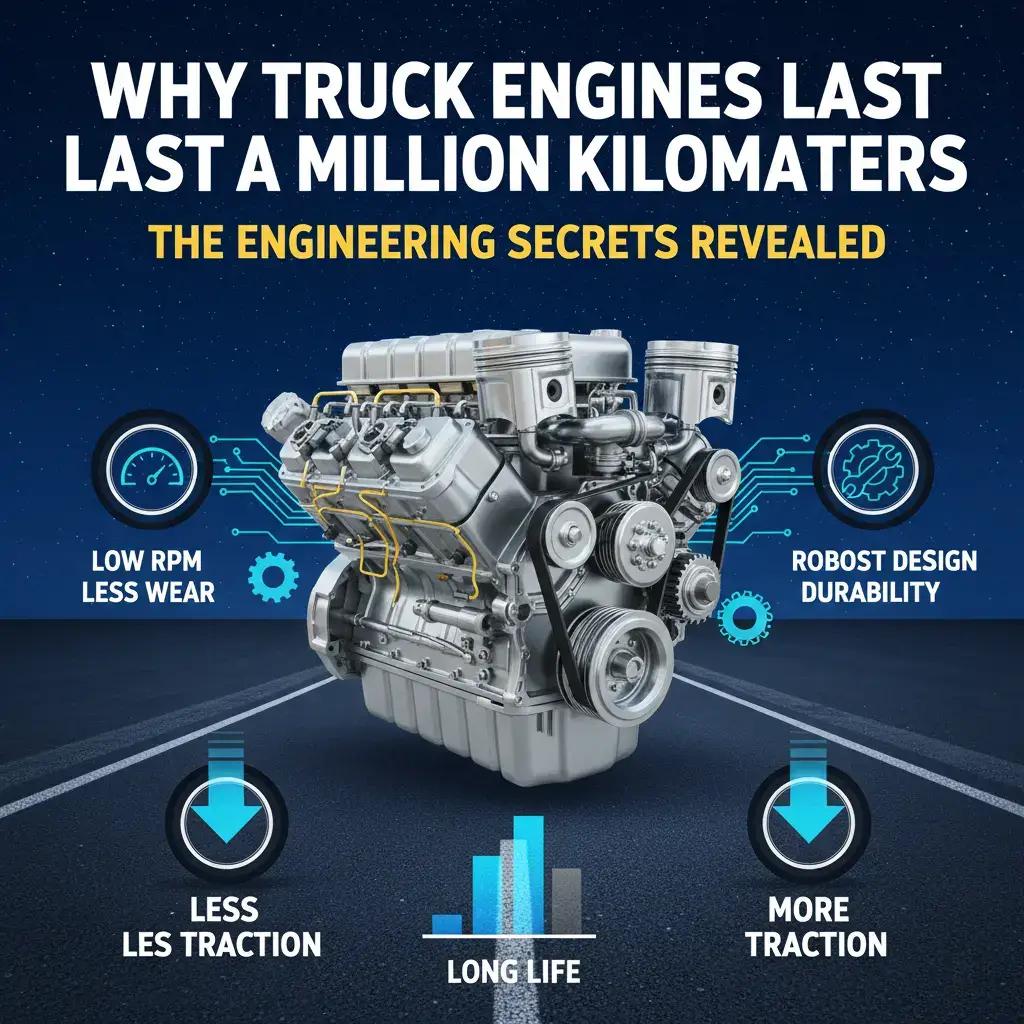
Why Truck Engines Last a Million Kilometers
When people hear that some truck engines routinely exceed 1,000,000 km, the reaction is usually disbelief. Many assume it’s because trucks “drive slowly” or because diesel engines are “stronger by default.” That’s incomplete and lazy thinking.
The real reason truck engines last so long is engineering philosophy. Trucks are designed around continuous load, thermal stability, and mechanical margins, not short-term performance or marketing numbers.
Let’s break it down properly.
1. Truck Engines Are Understressed by Design
This is the number one reason, and nothing else comes close.
A typical passenger car engine might:
Produce 80–120 hp per liter
Regularly operate near its RPM limit
Be optimized for weight, emissions, and cost
A heavy-duty truck engine:
Produces 20–40 hp per liter
Operates at low RPM (1,200–1,800 rpm)
Is designed to run fully loaded for hours
Lower specific output = lower internal stress.
Less stress means:
Lower bearing loads
Lower piston speed
Less heat concentration
Slower wear over time
This alone explains why truck engines age slowly.
2. Low RPM = Massive Longevity Gains
Engine wear is strongly correlated with mean piston speed and cycles per kilometer.
A car engine at 3,000 rpm:
Completes ~50 revolutions per second
A truck engine at 1,500 rpm:
Completes half that
Over 1 million kilometers:
The truck engine experiences tens of millions fewer combustion cycles
Fewer cycles = less:
Ring wear
Cylinder wall wear
Bearing fatigue
Valve train stress
RPM kills engines long before kilometers do.
3. Heavy-Duty Internal Components
Truck engines use materials and dimensions that would be considered overkill in cars.
Common features:
Forged steel crankshafts
Thick cylinder liners
Oversized bearings
Large oil capacities (30–40 liters)
Massive cooling jackets
These engines are not designed to be light.
They are designed to survive continuous punishment.
Passenger cars trade durability margin for:
Fuel economy
Emissions
Weight
Cost
Trucks don’t.
4. Superior Cooling and Thermal Stability
Heat is the silent engine killer.
Truck engines:
Run at lower RPM
Produce torque at low speed
Have enormous cooling systems
This leads to:
Stable combustion temperatures
Less oil breakdown
Reduced thermal expansion stress
A car engine experiences constant heat spikes:
Cold start
Short trips
Stop-and-go traffic
A truck engine:
Warms up once
Stays at operating temperature for hours
Thermal stability dramatically increases engine life.
5. Diesel Combustion Is Slower and Gentler
Diesel engines don’t rev high — and that’s a feature, not a flaw.
Diesel characteristics:
Higher compression
Slower flame front
Longer power stroke
Lower peak RPM
This results in:
Smoother torque delivery
Lower shock loads on bearings
Reduced valve train stress
Modern diesel emissions systems reduce reliability around the engine — but the core engine block remains extremely durable.
6. Constant Load Is Better Than Variable Load
This sounds counterintuitive, but it’s true.
Truck engines:
Operate at steady RPM
Pull consistent loads
Avoid rapid throttle changes
Car engines:
Constant acceleration/deceleration
Frequent cold starts
High transient loads
Engines wear fastest during:
Cold starts
Rapid RPM changes
High thermal swings
Trucks avoid all three most of the time.
7. Maintenance Is Non-Negotiable
Trucks survive because:
Oil changes are frequent
Fluids are monitored
Filters are oversized
Failures are expensive, so prevention is strict
A truck engine doesn’t survive abuse.
It survives discipline.
Engines that reach a million kilometers are not “lucky” — they are maintained correctly.
8. Engine Speed Matters More Than Speed on the Road
This is the final truth.
A truck cruising at 90 km/h:
Engine spinning at ~1,300 rpm
A car at 120 km/h:
Engine spinning at ~2,800 rpm
Over long distances, engine RPM exposure, not road speed, determines lifespan.
Final Reality Check
Truck engines last a million kilometers because:
They are underpowered on purpose
They run slowly
They are massively overbuilt
They operate under stable conditions
They are maintained seriously
If you build a car engine the same way, it would also last forever — but it would:
Be heavy
Be expensive
Fail emissions targets
Sell poorly
Longevity is a choice, not a mystery.
External Technical & Scientific Sources
Cummins – Engine Design for Durability
https://www.cummins.com/enginesSAE International – Heavy-Duty Diesel Engine Design
https://www.sae.org/publications/technical-papersWikipedia – Diesel Engine Operating Characteristics
https://en.wikipedia.org/wiki/Diesel_engineEngineering Explained – Why Diesel Engines Last So Long
https://www.youtube.com/watch?v=6hF5U8vHk8M
Table of Contents